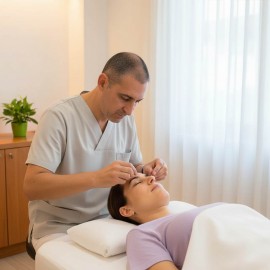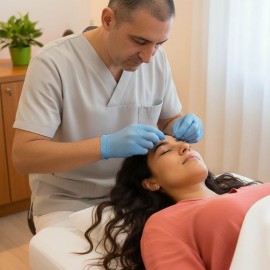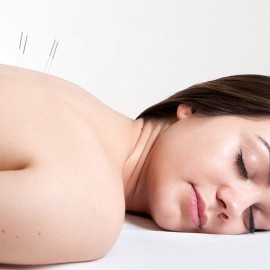
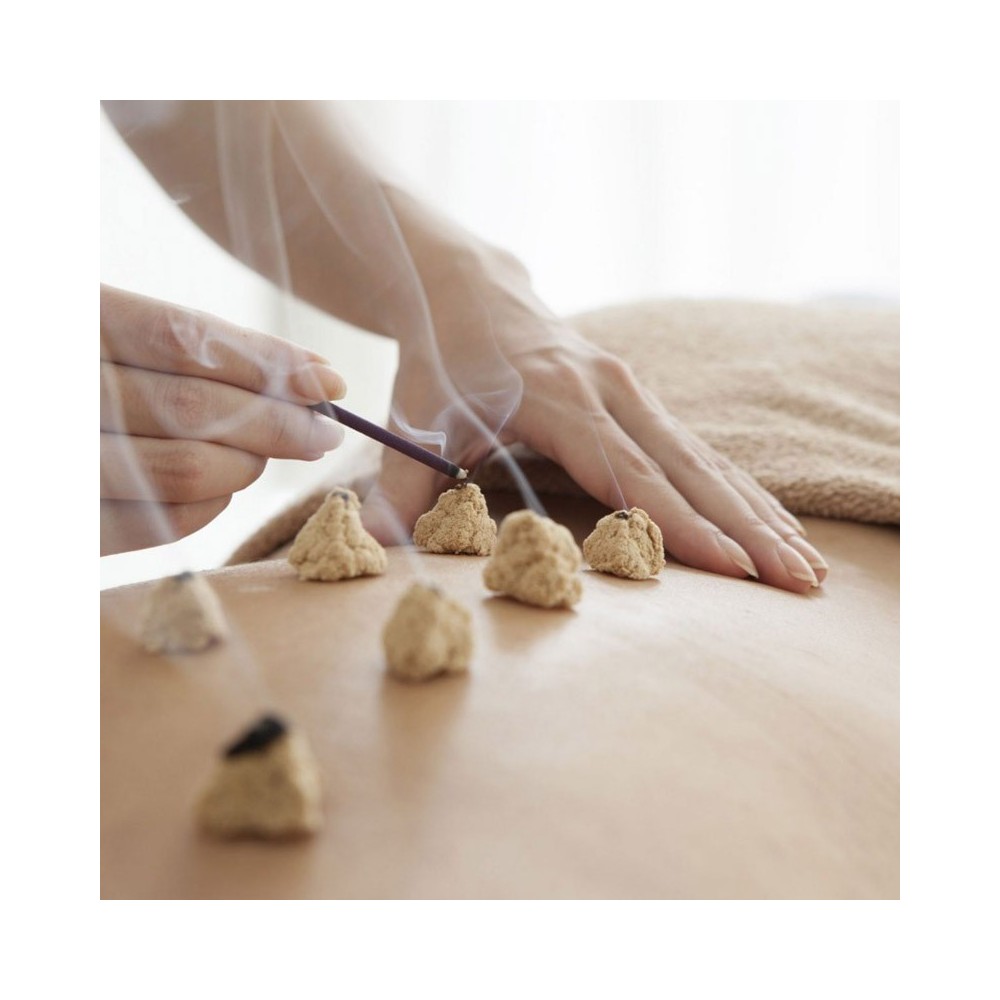


Moxibustion is a common practice in Traditional Chinese Medicine that uses the combustion of the Artemisia plant (moxa) near or over acupuncture points to stimulate vital energy and balance the body. The deep, gentle heat it generates promotes blood circulation, strengthens the immune system, and helps relieve muscular, joint, and digestive pain. It is also used in cases of fatigue, internal cold, and to enhance overall well-being. Moxibustion is a natural, safe, and complementary technique to acupuncture.
Moxibustion is one of the oldest and most recognized practices within Traditional Chinese Medicine (TCM). Although acupuncture is often the best-known technique in the West, moxibustion holds an equally important place among the therapeutic methods aimed at restoring the body’s energy balance. Based on the principle of stimulating and toning the flow of vital energy or Qi, moxibustion uses the heat produced by the combustion of an ancient plant: Artemisia vulgaris or mugwort.
The main goal of this therapy is to provide therapeutic heat to specific points of the body, generally the same ones used in acupuncture, in order to promote the circulation of energy and blood, dispel cold and dampness, and stimulate the body’s self-healing capacity.
Unlike purely physical treatments such as massage or physiotherapy, moxibustion works at the intersection of the physical, energetic, and emotional, offering a holistic approach that seeks to harmonize both body and mind.
The practice of moxibustion dates back thousands of years. Ancient Chinese medical texts, such as the Huangdi Neijing (The Yellow Emperor’s Classic of Internal Medicine), already described the importance of this technique as a complement to acupuncture. In tradition, it is said that the fire of moxa represents the light of the sun and its ability to bring back life, warm the cold, and revitalize the weak.
Over the centuries, moxibustion spread beyond China, reaching Japan, Korea, Vietnam, and other Asian countries, where it adapted and evolved in various forms. In Japan, for example, it is common to practice direct moxibustion on the skin using small amounts of mugwort, while in the West the most popular method is the moxa stick, similar to a cigar, which allows heat to be applied without direct contact.
In simple terms, moxibustion is the therapeutic application of heat generated by burning mugwort on specific points of the body. There are several application methods chosen at the acupuncturist’s discretion:
Direct moxibustion: small balls of moxa are placed directly on the skin and lit, removed before they can cause harm.
Indirect moxibustion: the moxa stick (cigar) is lit and brought close to the skin, held a few centimeters away.
Moxa on needle: a small moxa cylinder is placed on top of an acupuncture needle inserted into the body, transmitting heat deeply.
Moxibustion with devices: wooden boxes, cones, or special tools designed to hold moxa and direct heat to larger areas of the body.
Traditional Chinese Medicine explains moxibustion in terms of yin-yang balance and energy flow. Cold, dampness, and energy deficiency are considered pathogenic factors that weaken the body. Moxibustion provides yang heat, moves Qi and blood, and expels accumulated pernicious energy.
From a biomedical perspective, several studies have shown that moxibustion:
Stimulates microcirculation.
Promotes endorphin production (natural pain relief).
Activates the immune response.
Improves digestive and metabolic function.
Regulates the autonomic nervous system, promoting relaxation and balance.
Some of the most notable benefits are:
Relief of chronic pain: widely used in arthritis, osteoarthritis, lower back pain, neck pain, and muscle pain.
Improved digestion: helpful in cases of gastritis, chronic diarrhea, or lack of appetite.
Strengthened immune system: increases overall resilience and helps prevent colds and recurrent illnesses.
Emotional well-being: by regulating energy flow, it promotes calm, reduces anxiety, and improves sleep quality.
Gynecological treatment: moxibustion is well-known for its effectiveness in painful or irregular menstruation and is even used in correcting breech presentation during pregnancy.
Recovery of vital energy: recommended for people with chronic fatigue, postpartum weakness, or convalescence.
Musculoskeletal pain
Lower back pain, sciatica, neck pain, knee pain, arthritis.
Moxa is applied to local pain points and energy points that strengthen Kidney Yang and the Liver, organs related to bones and tendons.
Digestive disorders
Indigestion, gastritis, chronic diarrhea, irritable bowel syndrome.
Points on the abdomen and meridians of the stomach and spleen are tonified.
Chronic fatigue and weakness
Patients with fatigue, anemia, or recovering from illness.
Sessions are applied on points such as the “longevity point” (Zu San Li, ST36) and the abdomen to revitalize Qi.
Respiratory diseases
Asthma, bronchitis, recurrent colds.
Moxa strengthens the defensive energy of the lungs, helps warm the body, and improves immune function.
Gynecology and fertility
Menstrual pain, irregular cycles, fertility issues.
Special mention: breech presentation in pregnant women. Moxibustion can stimulate fetal movement, increasing the likelihood of the baby turning naturally, always with prior authorization from a specialist.
General well-being
Many people use moxibustion preventively, especially in cold or damp seasons, to strengthen vital energy and enhance vitality.
A moxibustion session usually lasts between 30 and 45 minutes. The patient is placed in a comfortable position while the therapist lights the moxa. The most characteristic sensation is that of a gentle and deep warmth, often described as “pleasant and comforting.”
Unlike other heating methods (such as electric blankets), the heat from moxibustion penetrates more deeply and locally, stimulating inner layers and creating a feeling of renewal.
Moxibustion is a safe technique when applied by a trained acupuncturist, but some precautions exist:
Avoid use on inflamed areas, with fever, or active infections.
Do not apply over open wounds, recent scars, or very sensitive skin.
Moxibustion is an ancestral technique that combines tradition and effectiveness. Its ability to mobilize energy, tone the body, and relieve multiple ailments makes it a valuable tool within integrative medicine. Whether in its traditional form, with the aromatic richness of mugwort, or in its modern smokeless version, it remains a therapeutic resource capable of bringing balance, warmth, and well-being.
In a world where stress, fatigue, and chronic diseases are increasingly common, moxibustion offers a natural, safe, and effective alternative to restore vitality and health in an integral way.
Moxibustion in Alaró
Moxibustion in Alcudia
Moxibustion in Algaida
Moxibustion in Andratx
Moxibustion in Ariany
Moxibustion in Artá
Moxibustion in Banyalbufar
Moxibustion in Binissalem
Moxibustion in Búger
Moxibustion in Bunyola
Moxibustion in Calviá
Moxibustion in Campanet
Moxibustion in Campos
Moxibustion in Capdepera
Moxibustion in Costitx
Moxibustion in Deyá
Moxibustion in Escorca
Moxibustion in Esporlas
Moxibustion in Estellencs
Moxibustion in Felanitx
Moxibustion in Fornalutx
Moxibustion in Inca
Moxibustion in Lloret de Vista Alegre
Moxibustion in Lloseta
Moxibustion in Llubí
Moxibustion in Llucmajor
Moxibustion in Manacor
Moxibustion in Mancor del Vall
Moxibustion in Maria de la Salut
Moxibustion in Marratxí
Moxibustion in Montuiri
Moxibustion in Muro
Moxibustion in Palma de Mallorca
Moxibustion in Petra
Moxibustion in Pollensa
Moxibustion in Porreras
Moxibustion in Sa Pobla
Moxibustion in Puigpunyent
Moxibustion in Ses Salines
Moxibustion in Sant Joan
Moxibustion in Sant Llorenç des Cardassar
Moxibustion in Sencelles
Moxibustion in Santa Eugenia
Moxibustion in Santa Margarita
Moxibustion in Santanyí
Moxibustion in Selva
Moxibustion in Sineu
Moxibustion in Sóller
Moxibustion in Son Servera
Moxibustion in Valldemosa
Moxibustion in Villafranca de Bonany
* For home visits in Mallorca, an additional €30 fee will be charged for trips over 20 km from Palma.
One of the most effective applications of acupuncture is precisely aesthetic acupuncture, also called cosmetic acupuncture
The skin recovers smoothness and luminosity in a few sessions thanks to the effect this technique produces on circulation in the applied area.
Laser acupuncture combines the wisdom of traditional Chinese medicine with the precision of low-level laser therapy, stimulating energy points without needles, pain, or side effects. Ideal for relieving muscle pain, anxiety, stress, insomnia, inflammation, and chronic fatigue, this technique improves circulation, accelerates cell regeneration, and restores balance to body and mind.
Experience deep, natural well-being — book your laser acupuncture session and feel how the energy of light transforms your health from within.
Hijama is a traditional technique that goes back thousands of years, used to maintain health through the application of suction cups, finding writings that demonstrate this in the Chinese and Egyptian civilizations. This therapy is also widespread in Muslim countries as a therapeutic treatment.
The basis of Hijama is prevention and its use is one of the most widespread therapies in the world to maintain health, acting together with a balanced diet and a healthy lifestyle, so the hijama, together with a good diet and healthy exercise contribute to prevent diseases.
The Aticulum Therapy or Aticulumpuncture is undoubtedly one of the best known therapies for treating health imbalances through reflex points. It is a variant of acupuncture that focuses on the reflex areas of the body found in the atrial pavilions, treating the different reflex points of the ears by massage, pressure, the use of seeds or metal balls or needles (although this will depend on each case). It is a widely used therapy in cases of pain, addictions, stress and anxiety situations.
The Emotional Freedom Technique or EFT Tapping is an acupuncture technique without needles, which thanks to the stimulation of certain points of the energy meridians that run through our body, enables the release of stagnant energy and facilitates that said energy flow to rebalance our body. The effectiveness of EFT was recognized in 1979 by the World Health Organization (WHO)
This technique is indicated to rebalance our body in any type of emotional discomfort, and is very effective in cases of anxiety, stress, fears, phobias, emotional pain, anger, guilt and addictions in General.
As it is a acupressure technique, it is completely painless.
Acupuncture is an ancient, painless and safe practice that aims to rebalance the energy of the body by manipulating different points of the body. In this healing technique used in traditional Chinese medicine, very thin needles are used to stimulate specific points in the body. Most of these points are placed on lines called "meridians".
In Acupuncture the disease is not defined by symptoms or by the name of a disease, but by energy imbalances, using terms such as Yin insufficiency or excess heat in the lungs.
The Chinese terms YIN and YANG refer to opposite energies that complement each other, and the term QI or CHI refers to vital energy.
Acupuncture is an ancient, painless and safe practice that aims to rebalance the energy of the body by manipulating different points of the body. In this healing technique used in traditional Chinese medicine, very thin needles are used to stimulate specific points in the body. Most of these points are placed on lines called "meridians".
In Acupuncture the disease is not defined by symptoms or by the name of a disease, but by energy imbalances, using terms such as Yin insufficiency or excess heat in the lungs.
The Chinese terms YIN and YANG refer to opposite energies that complement each other, and the term QI or CHI refers to vital energy.
The Aticulum Therapy or Aticulumpuncture is undoubtedly one of the best known therapies for treating health imbalances through reflex points. It is a variant of acupuncture that focuses on the reflex areas of the body found in the atrial pavilions, treating the different reflex points of the ears by massage, pressure, the use of seeds or metal balls or needles (although this will depend on each case). It is a widely used therapy in cases of pain, addictions, stress and anxiety situations.
Laser acupuncture combines the wisdom of traditional Chinese medicine with the precision of low-level laser therapy, stimulating energy points without needles, pain, or side effects. Ideal for relieving muscle pain, anxiety, stress, insomnia, inflammation, and chronic fatigue, this technique improves circulation, accelerates cell regeneration, and restores balance to body and mind.
Experience deep, natural well-being — book your laser acupuncture session and feel how the energy of light transforms your health from within.
Moxibustion is a common practice in Traditional Chinese Medicine that uses the combustion of the Artemisia plant (moxa) near or over acupuncture points to stimulate vital energy and balance the body. The deep, gentle heat it generates promotes blood circulation, strengthens the immune system, and helps relieve muscular, joint, and digestive pain. It is also used in cases of fatigue, internal cold, and to enhance overall well-being. Moxibustion is a natural, safe, and complementary technique to acupuncture.